Particles
Introduction
AthenaK can evolve Lagrangian particles alongside (or independently of) the fluid. Particles
are distributed across the same MeshBlock decomposition as the mesh and are migrated between
blocks (and MPI ranks) as they move. The module is under active development; the current
public version supports cosmic_ray particles advanced with a simple drift pusher, and
is primarily useful as the scaffolding for particle-based physics and for tracer diagnostics.
Particles require a 2D or 3D mesh (1D is not supported).
Inputs
Particles are enabled by adding a <particles> block:
ppc(default1.0): particles per cell. The total number allocated on a rank isppctimes the number of active cells across its MeshBlocks (fractional values< 1are allowed).particle_type(mandatory): the particle physics type. Currently the only supported value iscosmic_ray.pusher(mandatory): the time-integration algorithm. Currently the only supported value isdrift.assign_tag(defaultindex_order): how unique particle tags are assigned; eitherindex_order(sequential across ranks) orrank_order.
The number of particles is set by ppc, but their initial positions and velocities are
set by the problem generator, not by the input file. The bundled part_random generator,
for example, seeds each particle at a random position within its MeshBlock with a random
velocity.
Outputs
Particles use dedicated output file types (set via <output>/file_type):
pvtkwithvariable = prtcl_all: dumps all particles to a VTK file. Each particle records its position, owning MeshBlockgid, andptag.trkwithnparticles = <N>: appends a time series for a tracked subset (theNparticles with the smallest tags), writing position and velocity for each. Novariableline is needed for this type.
In addition, the particle number density can be binned onto the mesh and written with any
mesh output type by requesting variable = prtcl_d (the field is named pdens). This is
the easiest way to visualize the particle distribution with the standard slice tools.
Example: randomly drifting particles
The part_random problem generator fills the domain with randomly placed particles, each
given a random constant velocity, and lets them drift across MeshBlock and rank boundaries —
a good exercise of the particle infrastructure. AthenaK ships an input file at
inputs/particles/random_particle_drift.athinput.
1. Build the problem generator (it is a custom generator, selected at build time):
cmake -B build -DPROBLEM=part_random
cmake --build build -j
2. Note the particle block:
<particles>
particle_type = cosmic_ray
ppc    = 0.01           # particles per cell
pusher = drift
3. Slightly modify it. The shipped file is a large 3D run; shrink the grid so it runs in
seconds and write the particle density to the native binary format so it can be visualized
with the slice plotter. Reduce the <mesh> and <meshblock> sizes (keep all three
dimensions — the part_random generator is 3D), and switch the density output to binary:
<mesh>
nx1 = 64
nx2 = 64
nx3 = 64

<meshblock>
nx1 = 32
nx2 = 32
nx3 = 32

<output1>
file_type = bin         # native binary dump
variable  = prtcl_d     # particle number density on the mesh
dt        = 0.01
4. Run and visualize the particle number density (plot_slice.py takes a midplane slice
of the 3D dump automatically):
./build/src/athena -i inputs/particles/random_particle_drift.athinput -d run
python3 vis/python/plot_slice.py run/bin/random.prtcl_d.00016.bin pdens parts.png --notex
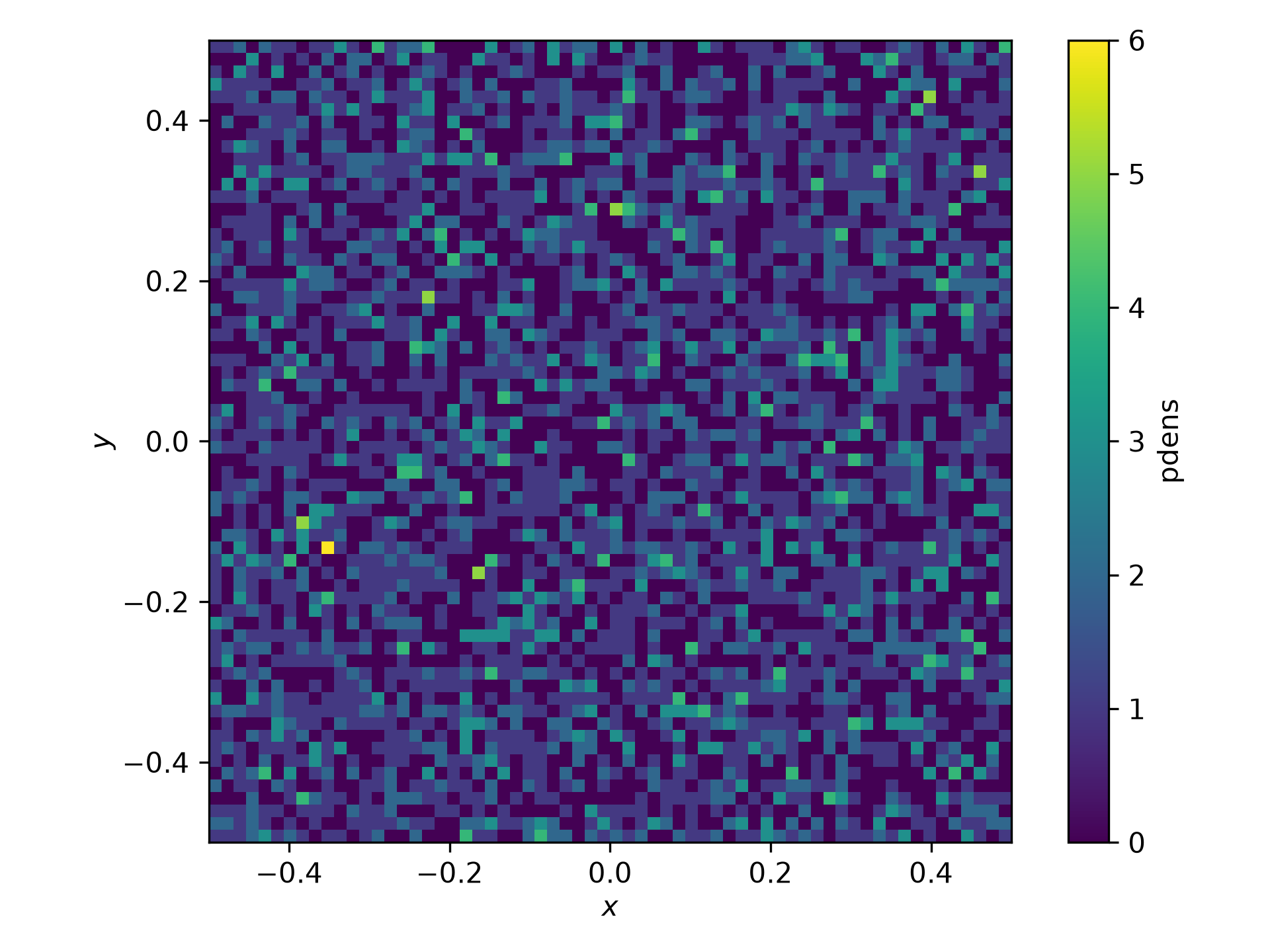
The binned particle density is nearly uniform (as expected for a random distribution), with Poisson fluctuations from cell to cell:
To follow individual trajectories instead, add a trk output with nparticles set to the
number of particles you want to track.